
CANNABIS
Anoka’s City Pot Shop Posts Thin Monthly Profits
Anoka’s government-run cannabis shop is ringing up $375,000 to $475,000 a month, with about $33,000 left after costs, and must still allow two private stores.

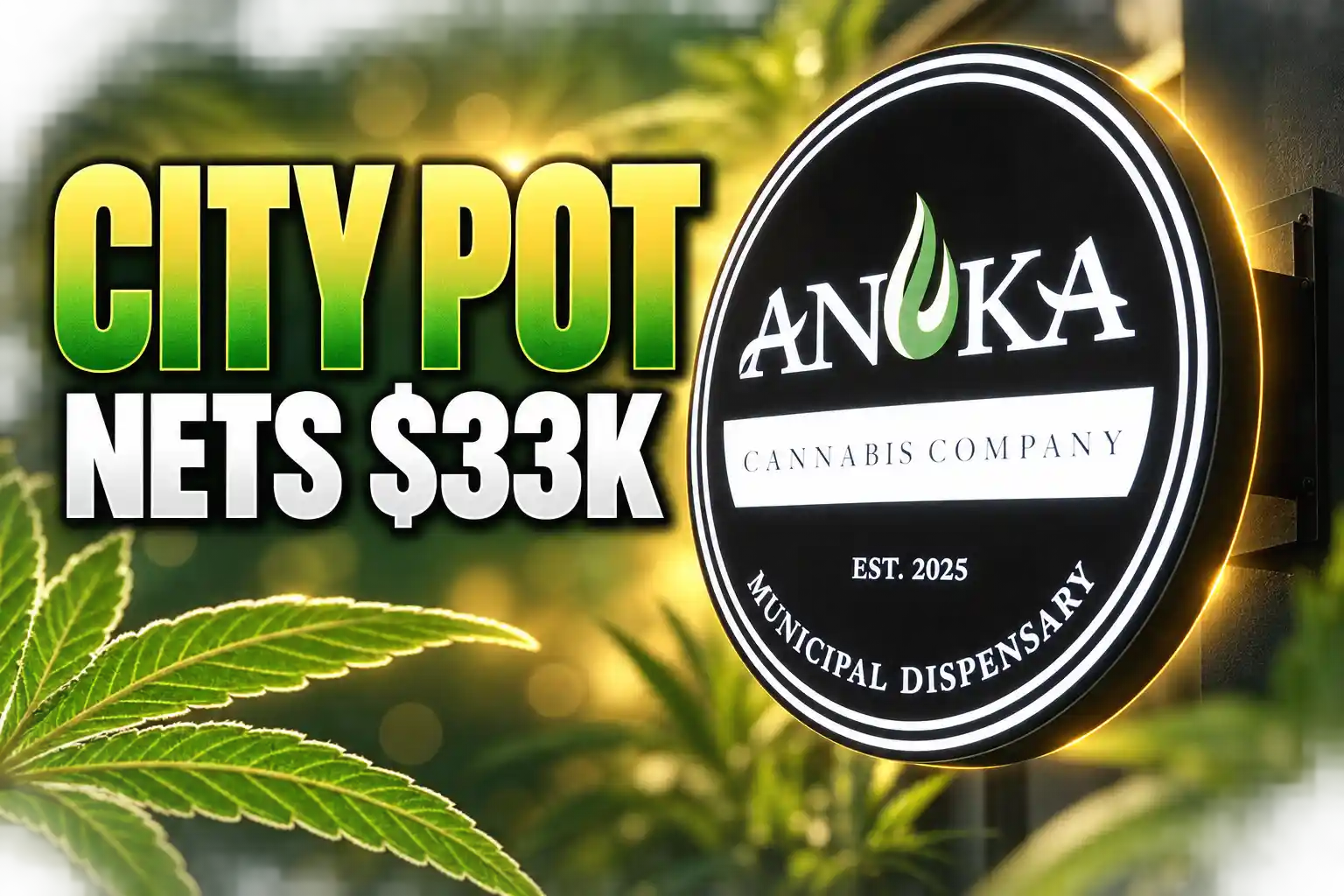
Anoka Cannabis Company rang up about $375,000 to $475,000 a month in its first five months. The city-owned shop on East River Road keeps those receipts for Anoka, with about $33,000 a month left after expenses, according to figures the city shared with Brooklyn Park staff in August 2026.
Mayor Erik Skogquist said the counter would control a regulated product and ease the tax burden on about 18,000 residents. State law still makes Anoka leave room for two private cannabis stores, a break from the liquor monopoly it has held since 1937.
A Storefront on East River Road
The shop sits at 839 East River Road, next to Better Values, the city liquor store. Construction of the nearly 3,000-square-foot building started in mid-May 2025, with a groundbreaking on May 22, before the state license was in hand. Oertel Architects and RJM Construction handled the job. The building inspection passed in January 2026.
A community open house ran February 4 with no sales. The ribbon cutting was February 5 at 2 p.m. Appointments opened at 10 a.m. on February 6, and walk-ins started February 9. Hours are 10 a.m. to 9 p.m. Monday through Saturday and 11 a.m. to 5 p.m. Sunday. The posted hours, address and product menu live on the shop’s own site, along with the line that profits stay in Anoka.
The city release listed a secure sally port, more than 35 cameras, reinforced glass, and solar panels for 88% of its power. Flower, vapes, edibles, drinks, and accessories went on the shelves. Kevin Morelli, the city’s enterprise operations director, said the shop was buying from the Prairie Island Indian Community and the Mille Lacs Band of Ojibwe. Stephanie Rietz manages the store. Jamie Croyle is assistant manager. The shop phone is 763-576-2967.
THE OPENING BET
- The building: Nearly 3,000 square feet beside the city liquor store, inspection passed in January 2026.
- The first sales: Appointments on February 6, 2026, walk-ins on February 9.
- The public line: 100 percent of net profits are supposed to return to Anoka.
- The staff claim: Rietz said almost all of the income is meant for levy breaks, new parks, and recreation facilities.
Skogquist put the civic pitch in writing before the doors opened.
Our residents want a safe, vibrant, and well-maintained community while keeping taxes as low as practicable. Anoka Cannabis Company allows the City of Anoka to do just that. We aim to safely control the sale of a regulated substance, set a high bar for others to follow, and use profits to lessen taxpayer burdens while further investing in the community.
Erik Skogquist, Mayor of Anoka, January 27, 2026 city release
He added that opportunities like this rarely come along and that Anoka intended all 18,000 residents to see the benefit. Rietz, in the same release, said education sat at the heart of the shop’s mission and that customers should know the purchase benefits the community.
The Shop Is Busy and the Margin Is Thin
Jennifer Erickson, a senior project manager in Brooklyn Park’s economic development and housing division, told her council in August 2026 that Anoka had shared numbers from its first five months of retail cannabis. She said the shop was bringing in around $375,000 to $475,000 a month in gross revenue, which came out to around $33,000 a month in net profit after expenses.
Those monthly gross figures already run about 2.0 to 2.6 times Better Values’ 2024 sales pace. Minnesota’s state auditor put Anoka’s 2024 liquor sales at $2,229,039, or about $185,753 a month. Cannabis is moving more product. The cut that remains after costs is another matter. About $33,000 a month annualizes to about $396,000 if the pace holds, above the liquor shop’s 2024 net of $339,883 and well below the fat park dividend some councils still picture when they say municipal cannabis.
At opening, Skogquist said the new store was expected to bring in between $1 million and $2 million a year. He did not say whether that was gross or net. The later monthly gross sits far above a $1 million to $2 million annual gross. The later monthly net does not look like a $1 million to $2 million annual profit. The useful comparison is the one Anoka actually ran next door.
LIQUOR 2024 VERSUS CANNABIS, FIRST FIVE MONTHS
| Figure | Better Values Liquor, 2024 | Anoka Cannabis Company |
|---|---|---|
| Sales | $2,229,039 for the year | $375,000 to $475,000 a month |
| Net profit | $339,883 for the year | about $33,000 a month |
| Share of sales | 15.2% | thin against that gross |
| Owner | City of Anoka | City of Anoka |
Erickson used those Anoka figures as a caution, not a template. She said Anoka is a different location and that Brooklyn Park should not base its own study on them. Shoppers have also hit empty cases, especially on vapes, with staff pointing at testers and slow Minnesota supply. Volume is not the same thing as a full shelf or a fat margin.
How Anoka Learned This Trade in 1937
Anoka has sold liquor since 1937. Better Values still advertises that profits stay in the city to maintain parks and hold down property taxes, with money set aside for the parks department and the capital improvement fund. In July 2023 the liquor store added low-dose cannabis drinks and edibles. Skogquist said those sales had been growing while traditional liquor and wine were falling, which helped make the cannabis-shop case.
The liquor side had been a poor teacher on profit. Morelli said a Highway 10 rebuild cut access to one store and sales dropped 66% overnight. The city later closed that shop. A big-box liquor store opened across the line in Coon Rapids, near the remaining Anoka location. Anoka posted the largest municipal-liquor profit losses in the state in those years: nearly $183,000 in 2022, then a $342,976 net loss in 2023 on $2,447,817 in sales, a 14.0% hole. In 2024, after the closed store was sold, the auditor’s table shows $339,883 in net profit on $2,229,039 in sales.
Statewide, the auditor counted 174 cities running 208 municipal liquor stores in 2024, with $436.4 million in sales, the first sales drop in 28 years, and $36.2 million in combined net profit. Twenty-seven cities still lost money. Anoka’s cannabis bet sits on that stack: a city that already knows how to staff a vice counter, that had just nursed liquor back into the black, and that wanted a new till before the old one sagged again.
FROM A LIQUOR COUNTER TO A CANNABIS COUNTER
- 1937: Anoka starts municipal liquor sales that become the Better Values brand.
- July 2023: The liquor store adds low-dose cannabis drinks and edibles.
- March 3, 2025: The city council votes 4-1 to order the cannabis project.
- May 22, 2025: Groundbreaking is held at 839 East River Road.
- June 16, 2025: The council authorizes an interfund loan from the electric utility, with Weaver again voting no.
- February 6, 2026: Retail sales begin by appointment.
- August 2026: Brooklyn Park staff recites Anoka’s first-five-month gross and net.
Morelli told a local interview the work was fun, exciting, and scary because Anoka was first, and that the store was a model for other communities. Skogquist said that once the city decided, the instruction was to do it, and that homework to opening day took less than a year.
Two Private Shops Must Be Allowed
Minnesota law lets a city or county own and operate a municipal cannabis store, and it also lets that city hold a lower-potency hemp edible retailer license. Anoka used that clause. The 2023 adult-use law does not let the city lock the door behind itself the way liquor still can.
On population, Anoka falls in the 12,501 to 25,000 band, so the state requires at least two local retail registrations. The council set the maximum at two privately operated shops and, on February 3, 2025, approved a policy for picking among multiple applicants. The city’s registration page is blunt: Anoka must allow two private cannabis retail registrations. The initial city fee is $500. A city ordinance says a city-run shop does not count against that private cap, so Anoka can have its own counter plus two private ones.
Buffers run 500 feet from schools, daycares, residential treatment, and park attractions used by minors. Retail is a permitted use in listed business and Main Street mixed-use districts. Only retail is allowed in the city for now. Through mid-2026, Anoka Cannabis Company was still the only licensed cannabis retailer operating inside city limits. The two private slots were a legal fact, not yet a line of competing storefronts on East River Road.
WHERE CANNABIS BREAKS THE LIQUOR MODEL
- The monopoly: Anoka can keep private liquor out. It cannot keep private cannabis out.
- The extra counter: The city shop does not fill the two private registration slots.
- The license path: A qualifying city can obtain a municipal retailer license without going through the private lottery.
- The fee: Private applicants still pay Anoka $500 to register locally after the state license.
That design is what opening-week critics missed when they called the shop a government monopoly that would jack up prices and crowd out small business. The statute points the other way. Anoka has to share the city. The fight is over whether a city should be on the floor at all, not over whether it can bar the door.
Weaver Pushed for a Private Partner
The March 3, 2025 vote was 4-1. Council Member Jeff Weaver was the no. He said he preferred a partnership with a private storefront and that he had not been real supportive of being a leader in the weed department. He also worried the Office of Cannabis Management still lacked a settled helm in St. Paul.
“I’ve not been real supportive of being a leader in the weed department. I’ve talked about a partnership with a private entity, I’m more amicable to that,” Weaver said. “Something about it doesn’t feel right to me. I know it’s legal, but I have concerns.”
He voted no again when bids were awarded in May 2025 and no again on the June 16, 2025 loan. Council Member Heather Rostad later called the opening a statement about how Anoka chooses to lead and noted the 35 cameras and the sally port. Council Member Sam Scott tied the shop to a longer civic habit, including the city power utility, and said Anoka looks out for its own. The majority treated cannabis as another municipal counter. Weaver treated it as a market the city should enter, if at all, with a private partner on the till.
Rietz later told a local station that almost all of the income would go back into the city for levy breaks and new parks and recreation facilities. That is the majority’s answer to Weaver: run it with city staff, keep the net, and spend it at home. The five-month net is the first public test of that answer.
Staff Floated the Shop With Utility Cash
On June 16, 2025, the council authorized an interfund loan from the electric utility to the cannabis fund, not to exceed $3,000,000, to build the shop at 839 East River Road. Minutes put estimated total construction at $2,794,006, including a construction-manager contingency. Security gear came in at about double the Point Seven consultant estimate, and the brick alternate added cost. Repayment is supposed to come from future cannabis sales, not a new levy.
The city page still lists the intended uses in the same breath as the liquor playbook: parks, improvements at Green Haven Golf Course, levy relief, and other municipal needs. Profits had not been locked to a single fund at opening. Skogquist said they might be used the way liquor proceeds are used, for public parks or to offset larger tax increases. Morelli listed parks, river projects, and possible levy cuts. The $33,000 monthly net is the number that would have to pile up, after the electric fund is paid back, before any of that list gets a check.
Point Seven, a cannabis consulting firm, had already sold Anoka a profitable path in a 2024 study, including a hypothetical at the Greenhaven clubhouse that nearby residents disliked as an address. Morelli said the firm needed an address to run the model and that it was only an example. The council still used the study to justify going in. The East River Road shop is the live version of that paper store.
Osseo, Brooklyn Park and the Copycat Line
Anoka called itself, at opening, the only city-managed dispensary then operating in the United States. North Bonneville, Washington, had run a municipal shop from 2015 to 2021 and then shut it. Minnesota’s 2023 law, and a city that already ran liquor, put a new one on the map. Other Minnesota cities lined up behind the same statute.
A dozen or more cities applied for municipal retail. Elk River paused. St. Anthony Village and Grand Rapids have talked about later openings. Blaine has discussed a retail store that Anoka Cannabis Company would operate, which would turn Anoka from a single-shop experiment into a city that runs cannabis for neighbors. Osseo broke ground on September 8, 2026, at 33 2nd Street Northeast, the old Osseo Press building, for a shop it is calling the Osseo Press Room. A private firm is slated to staff it. Those workers would not be city employees. That is Weaver’s model, built in the next town over, while Anoka’s model is city staff on a city payroll.
Brooklyn Park’s economic development authority voted August 17, 2026, to hire Point Seven for a feasibility study costing up to $25,200. Erickson said the point was to decide whether to apply when the window opens again, and that Anoka’s receipts were useful and not controlling. Other councils now have a live monthly pair to argue over: $375,000 to $475,000 in gross, about $33,000 in net, a city till without a liquor-style monopoly, and an electric-fund loan still sitting on the books.
CITIES WATCHING THE EAST RIVER ROAD TILL
- Osseo: Broke ground September 8, 2026, on a shop in the old newspaper building, with private staffing planned.
- Brooklyn Park: Ordered a study on August 17, 2026, after hearing Anoka’s five-month gross and net.
- Blaine: Has talked about a store Anoka Cannabis Company would operate.
- Elk River: Applied, then paused.
Anoka’s shop is still the city counter that is actually open. The $33,000 monthly net is the figure other councils are now passing around.

Vireo Bets $20 Million on Six Unopened Pennsylvania Stores

Alabama’s First Medical Cannabis Sale Left Three Shops

Medical Cannabis 280E Relief Stops at the 2026 Tax Year

The Water Still Leaves Trulieve’s Jefferson County Farm

Judge Undoes OMMA’s Public-Safety Shutdown of Cedric Gardens

LiUNA’s Half-Cent Buyout of Entourage Ended in CCAA

Breez Tablets Fill California Towns That Banned Shops

iAnthus Booked $6.294 Million for the Cheetah Vape Brand

A Virginia Checkbook Put Question 8 on the Ballot
Medical Cannabis 280E Relief Stops at the 2026 Tax Year
-
 CANNABIS2 years ago
LiUNA’s Half-Cent Buyout of Entourage Ended in CCAA
-
 CANNABIS2 years ago
Breez Tablets Fill California Towns That Banned Shops
-
 CANNABIS2 years ago
iAnthus Booked $6.294 Million for the Cheetah Vape Brand
-
 MARIJUANA10 months ago
A Virginia Checkbook Put Question 8 on the Ballot
-
 CANNABIS5 months ago
Medical Cannabis 280E Relief Stops at the 2026 Tax Year
-
 CANNABIS4 months ago
Alabama’s First Medical Cannabis Sale Left Three Shops
-

 HEMP2 years ago
Wana’s Total Wine Bet Meets a 0.4 mg Cap
-
 CANNABIS6 months ago
Missouri Put Metrc Out to Bid and Kept Using It