
CANNABIS
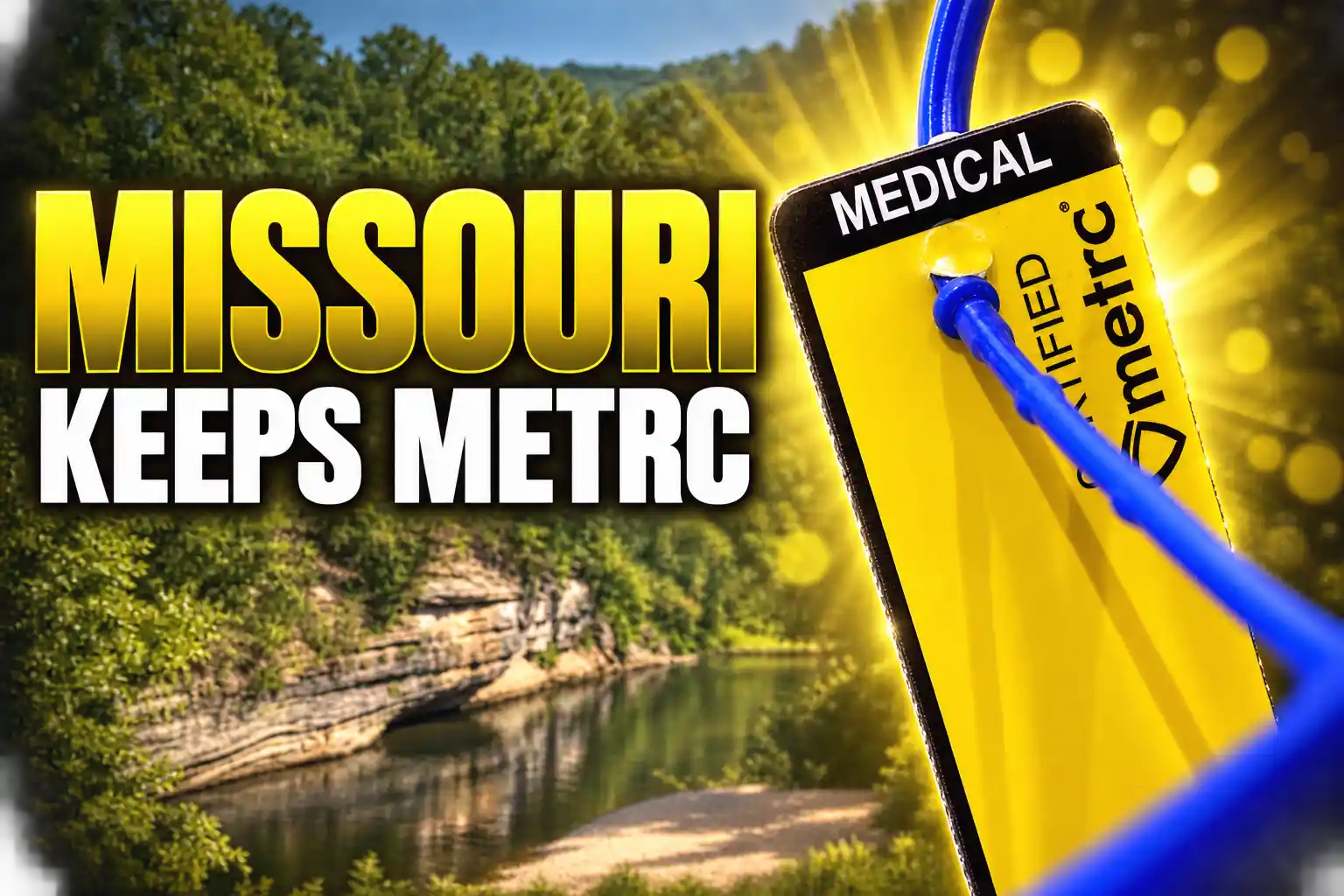
Missouri Put Metrc Out to Bid and Kept Using It
Missouri bid out seed-to-sale tracking after an audit dinged Metrc, but the expired contract still has no public successor and shops still run on it.

Missouri’s Division of Cannabis Regulation put its seed-to-sale tracker out to bid in March 2026, and the Metrc contract ended June 30, 2026 with no public winner. The bid asked for more than a new log of plants and packages. It asked for a single system to replace tracking, licensing, and back-office tools that have run the medical program since 2019 and adult-use sales since February 3, 2023.
State Auditor Scott Fitzpatrick’s February 2026 review had already said Metrc cannot flag purchases above constitutional limits as they happen. Bidding papers then told vendors the division needed an IT solution to replace the current systems. Months after the deal lapsed, dispensary software listings still named Metrc as Missouri’s tracker.
Missouri Asked for a Whole New Compliance Stack
The solicitation, STATE PURCHASE-FY25-0322-SL, went up March 11, 2026 through MissouriBUYS. A pre-proposal call was held March 24. Proposals were first due April 14 at 2:00 p.m. Central Time, then Amendment 02 moved that deadline to April 28 at 2:00 p.m. The incumbent listed in the papers is Metrc, with Complia as subcontractor on licensing work.
This is not a tracking-only refresh. The division asked for one commercial off-the-shelf platform covering seed-to-sale track-and-trace, applications and ID cards, licensing, case management, data tools, document management, and enterprise resource planning, plus training for state staff and licensees. The new deal would run two years from the award date, with options for five extra one-year terms. Bidders had to show either ten years building this kind of software for regulated markets or five years in cannabis, marijuana, or FDA-regulated work. The system had to support at least 200 state users at once and an unlimited number of outside users.
Delivery is front-loaded on the pieces shops and growers touch every day, and slower on the state’s own books.
THE RFP DELIVERY CLOCK
| Piece of the system | Clock after notice of award |
|---|---|
| Seed-to-sale track-and-trace | 120 days |
| Application and licensing | 120 days |
| Data tools | 120 days |
| Document management | 120 days |
| System architecture | 120 days |
| Full-service delivery lifecycle | 1 year plus 120 days |
| Enterprise resource planning | 2 years plus 120 days |
Work is tied to the Division of Cannabis Regulation in Jefferson City. Article XIV of the Missouri Constitution requires seed-to-sale tracking and tells the department to certify commercial systems that meet its standards, so the law already leaves room for more than one vendor. The bid is how that room gets used, if it gets used at all.
Fitzpatrick’s Audit Put Purchase Limits on the Table
Fitzpatrick released Report No. 2026-014 on February 18, 2026 and gave the marijuana program a fair grade. Most of the report is about license scoring, inspections, and money that had not moved out of veterans funds. The tracker showed up in a narrower, harder place: the statewide system could not see a sale that broke the constitutional cap while the sale was still open.
The statewide track and trace system, (Metrc) does not currently have the capability to identify purchases over the legal transaction quantity limits in real time. As a result, marijuana customers are able to purchase more cannabis than what is allowed by the Constitution, and there is an increased risk of diversion and a public safety concern.
Missouri State Auditor Scott Fitzpatrick, Report No. 2026-014, February 2026
Adult-use buyers are capped at 3 ounces of dried flower, or the equivalent, in a single transaction. Medical patients are capped at 6 ounces per 30 days, unless a clinician certifies a higher amount. Those limits only bite if the register, the patient file, and the state database agree before the bag leaves the counter. The audit said Metrc could not do that check in real time, and it told the division to identify purchases over the legal limits as they happen and to make dispensaries block them automatically.
The same report said the division had done few inventory inspections aimed at diversion, and that the Department of Revenue had not been set up to use Metrc data for tax audits of dispensary sales. A tracker that cannot catch an over-limit sale and cannot feed the tax office is a weaker spine than the public pitch for seed-to-sale usually claims. Fitzpatrick also said Health and Senior Services staff fought the audit and used harsh language in their reply, which he called uncooperative.
Four Points Separated Metrc From BioTrack in 2019
Missouri has been here before, with a thinner stack and a photo finish. On March 4, 2019, the Office of Administration asked for a Medical Marijuana Information System with three parts: a patient registry, facility licensing, and seed-to-sale tracking. On April 5, 2019, the state named Metrc the lowest and best bid. A 2021 Missouri Court of Appeals opinion records Metrc’s 143 points to BioTrack’s 139 on a 218-point scale. Four points decided the pipe every licensed plant still moves through.
BioTrack protested. The fight did not stop at scoring. Industry groups and Metrc later tangled over whether the firm, fixed price covered proprietary RFID tags or whether growers and shops could be billed extra for them. The appeals court said the 2019 deal did not let Metrc charge the state or licensees for those tags on top of the fixed price. Tag fees are a small line item on paper and a daily cost on a cultivation floor that has to tag every plant the state can see.
State contract records show the original term ran five years after the state accepted the system, with two optional one-year renewals. Those options were used. Amendments later folded in adult-use marijuana after Amendment 3 passed in 2022. The last renewal ran through June 30, 2026. In 2025, BioTrack’s government-contract work moved under Metrc, which left the 2026 rebid with a thinner field than the 2019 contest.
FROM THE FIRST AWARD TO THE REBID
- March 4, 2019: Office of Administration posts the medical marijuana information-system bid.
- April 5, 2019: State awards Metrc after a 143-139 score over BioTrack.
- 2022: Voters pass Amendment 3; Metrc’s contract is amended for adult use.
- February 3, 2023: Adult-use retail sales begin on the same tracker.
- February 18, 2026: Auditor’s Report No. 2026-014 flags the real-time limit gap.
- March 11, 2026: Division posts the full-stack replacement bid.
- June 30, 2026: Metrc agreement ends; no public successor is named.
The first contest was close enough that a protest followed. The second contest arrived after Metrc had taken over the government business of the firm that almost beat it.
A Dead Connection Stops the Sales Floor
Missouri rules make the statewide tracker a live switch, not a nightly report. Licensees have to keep the state system accurate every day and fix errors as soon as they are found. If a shop’s seed-to-sale software fails or drops its link to the state system, tracked activity has to stop. The failure has to be reported within three hours, and records have to be reconciled once the link is back. A cutover that blinks is not an IT ticket. It is a closed register.
The division has already used that switch as an enforcement tool. On August 8, 2024, the Department of Health and Senior Services recalled marijuana sold by C&C Manufacturing, LLC.
The recalled marijuana products were not compliantly tracked in the statewide track-and-trace system called Metrc as mandated by 19 CSR 100-1. Therefore, we cannot verify compliance with health and safety requirements. No adverse reactions have been reported at this time.
Missouri Department of Health and Senior Services, August 8, 2024
The department told patients and customers to stop using the recalled lots and to discard them or return them to the dispensary, and it posted the lots with other products not compliantly tracked in Metrc. That is the operator’s bind in one sentence. If the tracker is down, sales stop. If product never hits the tracker, the state can pull it from shelves even when no one has reported getting sick. Shops do not get a vote on the vendor, and they eat the halt either way.
What a Vendor Switch Would Demand of Licensees
A new award would start a 120-day clock to stand up track-and-trace, licensing, and data tools while every plant, package, transfer, and sale in the state is still moving. Cultivators, makers, transporters, and dispensaries would have to keep the old pipe accurate until the new one is certified, then cut over without a three-hour hole. Point-of-sale vendors that already sync to Metrc would have to rebuild those hooks. Staff who know Metrc’s harvest batches, package tags, and admin tabs would have to relearn the same jobs on a different screen.
WHAT A SWITCH PUTS ON OPERATORS
- The halt rule: Any loss of connection with the statewide tracker stops tracked activity and must be reported within three hours.
- The 120-day clock: Seed-to-sale, licensing, and data tools are supposed to be live within 120 days of notice of award.
- Register rewiring: Dispensary POS systems that auto-sync sales and allotments to Metrc would need new integrations before the first day on a successor.
- Tag and package habits: Plant tags, package IDs, transfers, and lab results would have to land in a new system of record without breaking chain of custody.
- The auditor’s fix: Fitzpatrick told the division to integrate real-time transaction analysis capabilities and to make dispensaries block over-limit sales automatically, which any winner has to actually ship.
Metrc’s own Missouri page still greets licensees on behalf of the division, points to Article XIV and 19 CSR 100-1, and hosts industry bulletins, including a January 22, 2026 note on harvest-batch practice. That page is how a lot of shops still learn the rules of the current pipe, even after the contract date on the state’s books.
Metrc Still Runs Missouri’s Live Market
IndicaOnline’s Missouri market page, refreshed in September 2026, still listed Metrc as the statewide seed-to-sale system and sold its POS on real-time Metrc sync. Dutchie’s Missouri compliance guide, last reviewed June 14, 2026, said the same. Those pages are ads, not award notices, but they are how stores actually configure a register. If a successor were live, those vendors would be racing to announce the new hook. They were not.
Public argument about the rebid itself almost vanished after April 2026. The silence fits a market whose software, SOPs, and recall process already assume Metrc. Licensees cannot pause a flowering room while Jefferson City scores proposals. On September 24, 2026, Metrc said it had extended its track-and-trace partnership with Colorado’s Marijuana Enforcement Division, a reminder that other states are renewing the same vendor Missouri just tried to shop.
WHAT WE KNOW
- The bid: STATE PURCHASE-FY25-0322-SL asked for a full replacement of tracking, licensing, and related systems, with proposals due April 28, 2026.
- The audit: Report No. 2026-014 found Metrc could not flag over-limit purchases in real time and tied that gap to diversion risk.
- The contract date: State contract records put the Metrc agreement’s end at June 30, 2026, after both one-year renewals were used.
- The live pipe: In September 2026, vendor listings and Metrc’s own Missouri page still treated Metrc as the statewide tracker.
WHAT IS UNCONFIRMED
- The winner: No public award naming Metrc, a successor, or a dual-running pair has been posted.
- A short extension: It is not public whether the state signed a bridge deal to keep Metrc on after June 30, 2026.
- Go-live: No date has been announced for a 120-day cutover, a dual-system period, or a drop-dead switch.
The Missouri Metrc training and bulletin page is still the public front door for the system the 2026 bid was written to replace. Until Jefferson City names a vendor, that is the pipe cultivators tag to and the pipe a recall still cites.

Vireo Bets $20 Million on Six Unopened Pennsylvania Stores

Alabama’s First Medical Cannabis Sale Left Three Shops

Medical Cannabis 280E Relief Stops at the 2026 Tax Year

The Water Still Leaves Trulieve’s Jefferson County Farm

Judge Undoes OMMA’s Public-Safety Shutdown of Cedric Gardens

LiUNA’s Half-Cent Buyout of Entourage Ended in CCAA

Breez Tablets Fill California Towns That Banned Shops

iAnthus Booked $6.294 Million for the Cheetah Vape Brand

A Virginia Checkbook Put Question 8 on the Ballot
Alabama’s First Medical Cannabis Sale Left Three Shops
-
 CANNABIS2 years ago
LiUNA’s Half-Cent Buyout of Entourage Ended in CCAA
-
 CANNABIS2 years ago
Breez Tablets Fill California Towns That Banned Shops
-
 CANNABIS2 years ago
iAnthus Booked $6.294 Million for the Cheetah Vape Brand
-
 MARIJUANA11 months ago
A Virginia Checkbook Put Question 8 on the Ballot
-
 CANNABIS4 months ago
Alabama’s First Medical Cannabis Sale Left Three Shops
-
 CANNABIS5 months ago
Medical Cannabis 280E Relief Stops at the 2026 Tax Year
-

 HEMP2 years ago
Wana’s Total Wine Bet Meets a 0.4 mg Cap
-

 CANNABIS6 months ago
California Strips the 10-Milligram Cap Off THC Drinks